Get In Touch
Leave your number and details below and we will call you right away!

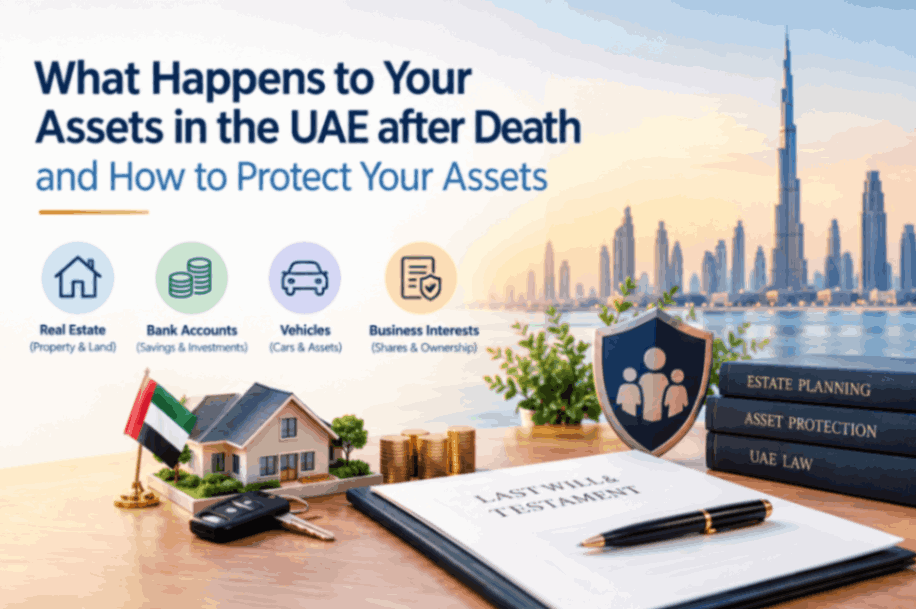
Living and working in the UAE often means building a life here – a home, savings, investments, a business, a property, a car. But have you ever wondered what happens to all of it if something happens to you?
The answer is not as simple as leaving everything to your spouse, children or family members.
When a person dies in the UAE, their estate must usually go through a legal process before assets can be transferred to the beneficiaries. This process is subject to probate requirements and the applicable inheritance laws.
The good news is that proper estate planning can simplify the process and help ensure your assets are handled in accordance with your wishes.
What Happens to Your Assets After Death?
In the UAE, a deceased person’s estate generally must go through administration before any assets can be distributed.
Depending on the circumstances, this may include identifying the deceased person’s assets and liabilities, securing the necessary court orders, settling outstanding obligations, and transferring the remaining assets to the rightful beneficiaries.
For families already coping with the loss of a loved one, going through this process without proper planning can create additional legal and administrative burdens.
What Happens If You Die Without a Will?
If you die intestate in the UAE, it means you have passed away without a valid, registered Will. In such cases, the administration and distribution of your estate will be governed by the applicable UAE laws, rather than by your personal wishes.
Depending on your circumstances, this can mean:
Your UAE assets may be subject to legal restrictions or freezing following your death.
Your family may have to go through the applicable succession and court process to access and transfer assets.
The distribution of your estate may be determined under the applicable statutory inheritance rules rather than your preferred wishes.
Debts and liabilities must generally be dealt with before the remaining estate is distributed.
The relevant court may need to issue the orders required for the administration and transfer of the estate.
Without a Will, your family may still inherit your assets, but they may first need to go through a legal process to access them.
A properly drafted and registered Will can provide greater certainty on how your assets should be dealt with after your death, who should benefit from them, and can help your loved ones avoid unnecessary uncertainty and delay.
A Will Is Not Only for the Wealthy
One of the most common reasons people postpone making a Will is:
“I don't have enough assets yet.”
Estate planning is not only about what you own today; it also prepares for how your circumstances may change over time.
In the future, you may purchase property, open new bank accounts, start a business, acquire shares, or have children. Certain Will structures may also cover assets acquired after the Will has been registered.
A Will should therefore be treated as part of broader financial and family planning, rather than as a document intended only for older or wealthy individuals.
Even a modest estate may include several assets that should be considered as part of your planning. These may include:
Bank accounts and savings
Real estate and property
Company shares and business interests
Vehicles and other personal belongings
Investments and brokerage accounts
Life insurance and other financial interests
Digital assets, where applicable
Guardianship arrangements for minor children
How Can You Protect Your Assets?
A practical estate-planning approach can include:
Identify your assets
Make a list of your UAE property, bank accounts, investments, business interests, vehicles and other significant assets.
Identify your beneficiaries
Decide who you want to benefit from your estate and how you want your assets to be distributed.
Consider guardianship
If you have minor children, consider who you would want to care for them.
Choose the appropriate Will structure
Different Will-registration systems and types of Wills have different eligibility requirements and scopes.
Register the Will properly
A Will should be prepared and registered in accordance with the applicable legal requirements. A professionally drafted and properly registered Will can provide greater certainty when your estate is eventually administered.
Review your Will regularly
Marriage, divorce, the birth of a child, acquisition of property, changes in business interests or moving to another country may require your Will to be reviewed or updated.
Protect Your Assets Before You Need To
Nobody likes thinking about what will happen after they are gone.
But estate planning is ultimately less about death and more about the people and things you leave behind.
A properly structured and registered Will can help reduce uncertainty, protect your family’s interests and ensure that your wishes are clearly documented.
At Firm Advice, we assist UAE residents and expatriates with Will planning and registration, including:
Consultation on the appropriate Will option
Professional Will drafting
Legal translation and documentation
Guardianship provisions for minor children
Assistance with asset and beneficiary planning
DIFC and ADJD Will registration support
Your assets took years to build. Take the time to plan what happens to them.
Contact Firm Advice today to discuss your UAE Will and estate-planning requirements.