Get In Touch
Leave your number and details below and we will call you right away!

Our lives are a journey unseen with a purpose to collect happy memories with loved ones as companions. We all travel this journey and leave without knowing the destination. A big satisfaction can be attained by knowing that our loved ones will be taken care of after we leave. As a short verse puts it:
“What we build is for those we leave behind,
Their future secured, our peace of mind.
For love plans ahead of the journey’s end,
To guard our homes and guide our friends.”
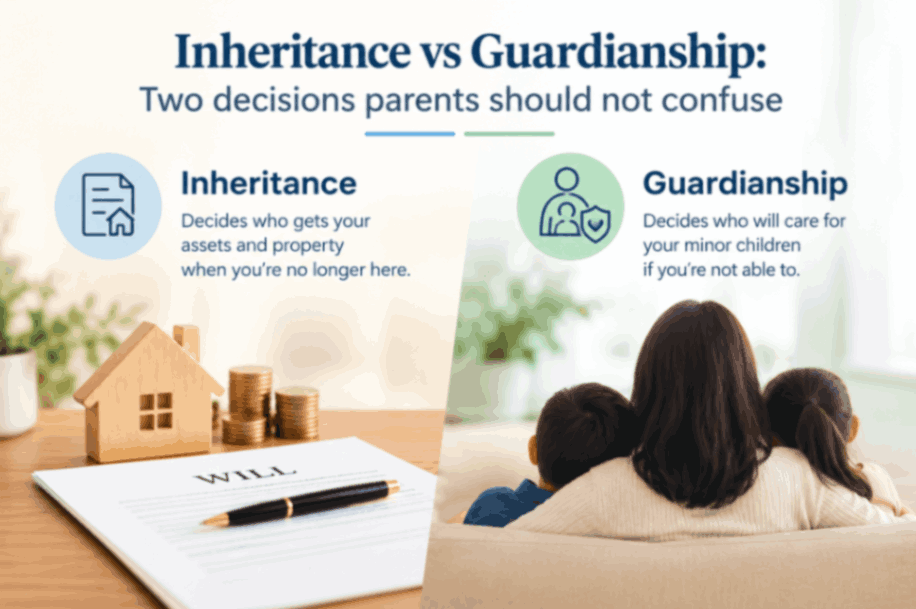
As lawyers, a common confusion we see in the minds of UAE expats is the distinction between inheritance and guardianship. To clear the confusion in one line, inheritance is about your property while guardianship is about your children. This article explains both in simple terms and what parents living in the UAE can do about each.
Inheritance answers one question: when you pass away, who gets what you owned? That usually means bank accounts, property, business shares, cars, and valuables like jewellery.
How your estate is divided in the UAE depends a lot on your religion and nationality.
If you're Muslim, Sharia inheritance rules apply by default. The authorities give fixed shares to close relatives such as your spouse, children, and parents. You can change that through a Will.
A civil will through ADJD is open to Muslim expats who aren't UAE or Gulf country nationals. It lets you direct your UAE estate in the same way a non-Muslim can. In effect, you step outside the Sharia default. Without a will, a Muslim's estate is divided strictly by the fixed shares as per Sharia
If you're non-Muslim, things are more flexible. You can register a will to say who gets your UAE assets, and you're free to name anyone. The main routes are the DIFC Wills Service Centre in Dubai and the the ADJD Wills in Abu Dhabi, and Civil Wills through Dubai Courts.
Whichever group you belong to, inheritance is only about assets. It says nothing about who will bring up your kids.
Guardianship, by contrast, centres on people, not property. The question it settles is who steps up to make the big calls for your child if you're no longer able to.
A guardian may have to decide about:
Choosing your child's school
Consenting to medical care
General supervision of your child's upbringing. Note that day-to-day care sits under a different legal role, custody.
Managing your child's money and assets, a duty that stays with the guardian until the child comes of age
Guardianship and custody are not the same thing. In UAE law, guardianship covers general supervision of the child and management of the child's property, while custody is the child's day-to-day care. For example, a mother who outlives the father might retain day-to-day custody even though guardianship itself gets settled independently - either through the father's will or by court order.
A guardian's job also covers money. Where a child inherits, it falls to the guardian to look after those assets for them until adulthood. The guardian merely administers this property - legal ownership sits with the child throughout, and full control shifts to them once they come of age. Note that the UAE recently reduced the age of majority from 21 to 18.
Inheritance vs guardianship at a glance
Inheritance | Guardianship | |
What it's about | Your assets and finances | Your child |
Who decides | Set by statute or your will | Mostly the law, though courts give weight to a parent's wishes when they are properly documented and registered |
Purpose | Transferring your estate to the next generation | Looking after your child until they're grown |
Ownership | Whoever inherits becomes the outright owner | A guardian only manages the child's property until the child reaches the age of majority, and big decisions like selling it can need court approval. |
Where the two meet
They overlap in one situation: a child who inherits.
Picture a seven-year-old inheriting a house and some savings after a parent's death. Legally the money and property belong to that child, but a seven-year-old obviously can't run a bank account or manage a property. Somebody has to step in on the child's behalf, and if no guardian was ever nominated, a judge will appoint one. Either route, an adult ends up in charge of those assets until the child grows up.
So a parent can plan their inheritance carefully and still leave a gap. The assets are accounted for, but nobody has been chosen to look after the child or the child's money.
There's no perfect candidate, but a few honest questions usually narrow the list.
Is there an existing bond of trust? A familiar, comfortable face softens what would otherwise be a very unsettling change for a child.
Do you parent alike? Views on schooling, religion, and discipline matter more over the years than most people expect.
Are they up to it? Think about age, health, and energy. This could be a commitment of ten years or more.
Where do they live? A guardian abroad can mean a new school, a new environment, and a new country for your kids. Sometimes that works, sometimes it doesn't.
Have they said yes? Ask them first, and pick a backup too.
Have you sorted out the funding? Raising your children shouldn't come out of your guardian's personal savings. Work out in advance where the money for everyday expenses, tuition, and medical bills will come from. Pick someone you're confident in handling both the caregiving side and the finances.
A judge steps in instead. The child's welfare drives that decision, and depending on the succession rules that apply to your family, a relative could well be appointed. Even a well-intentioned judge is a stranger to your family, so they can't factor in things you'd know instinctively - say, that your child is genuinely closer to a lifelong friend than to a distant relative. None of that gets considered unless you've put it in writing beforehand.
Thinking a will covers everything. Many wills deal only with assets. Even when a will names a guardian, it has to be drafted properly for the nomination to be recognised.
Assuming the surviving parent will handle it all. Even with one parent alive, questions can come up about who manages the child's inherited property. Guardianship does not automatically pass to a surviving mother in every case, even though she may keep custody of the children. You also need a backup in case both parents can't act.
Naming a guardian without asking them. Someone who doesn't know about the role, or doesn't want it, can cause real problems later. Have the conversation first.
Leaving the plan unregistered. A document in a drawer at home may not carry enough weight. Registering or notarising through the right channel often decides whether your wishes are followed.
Keep two lists. One for who gets your assets. One for who will raise your children and manage their affairs.
List your assets. Include UAE and overseas property, bank accounts, and business interests. It makes a lawyer's job easier and your advice better.
Pick a guardian and a backup. Choose people you trust, and a second person in case the first can't act.
Remember the guardian manages the money. Your guardian will manage your children's inherited assets until they come of age, so pick someone you trust with both the care and the money.
Talk to a UAE lawyer. The rules differ by religion, nationality, and emirate. For non-Muslim expats, whether a DIFC, an ADJD or Dubai Courts will suits you depends on what you want to achieve. For example, DIFC will guardianship provisions apply only where the children are resident in Dubai or Ras Al Khaimah, which matters if you may relocate.
Register your documents through the proper channel.
Review every few years, and after any big life change.
Nobody enjoys thinking about a future where they're not around. But if you don't decide, a court will, and it can't know which relative your child is closest to or how you wanted them raised.
Inheritance protects what you own. Guardianship protects the person you love most. They're separate legal questions, and the best plans deal with both together.
If you're a parent in the UAE and aren't sure your current arrangements cover both, a short consultation can show you where you stand. Our team is happy to walk you through the options.